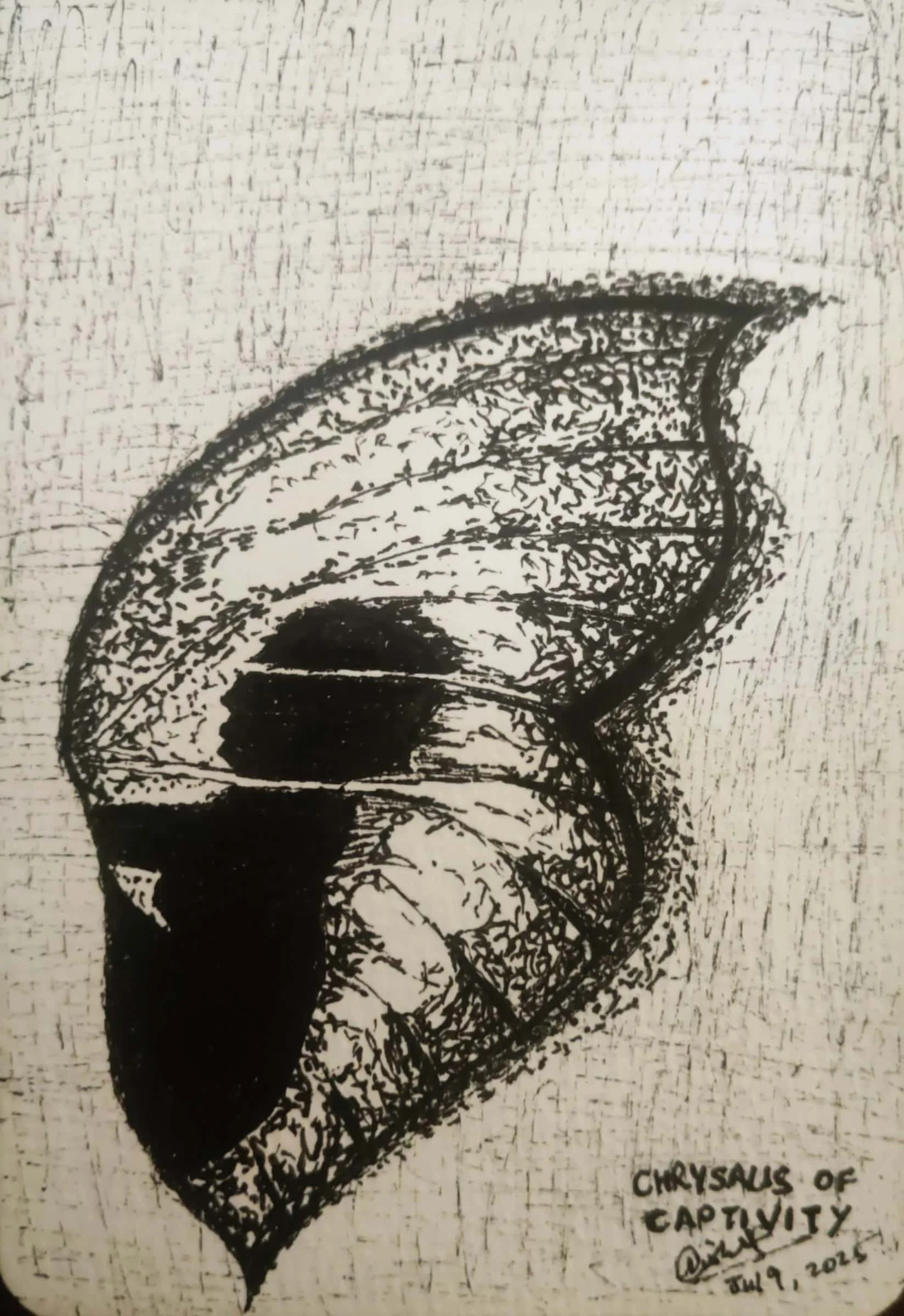
Title: “Shades of Conscription” and “Chrysalis of Captivity”
Artist: Nishita Rao
Date Created: April to July 2025
Words from the Artist: “We live in a society where, to receive basic human rights people have to subject themselves to State legibility. Categories that were once tools of recognition are now instruments of classification, regulation and exclusion, determining whose humanity and rights are recognized, acknowledged and protected. "Shades of Conscription" speaks to many non-binary voices who do not receive acknowledgement of the violence they had to endure. The art questions existing legal frameworks and societal perceptions of gendered violence.
Should a non-binary person be made legible through binary codes so that the State can recognize the crime committed against them?
Should they translate themselves into shades society recognizes so that their experience and bodily autonomy are acknowledged and respected?
Why must the body be conscripted into readable, legible, binary codes — shaded into categories recognizable by the State — before the person inhabiting it can access their fundamental human rights?
"Chrysalis of Captivity" speaks of how victim blaming and silencing of survivors start inside their society and inside their own houses. Speaking up about the abuse often results in the society ostracizing survivors. Why is society hell-bent on protecting its perpetrators, and refusing to name the abuse, thereby silencing survivors? The survivor's throat is squeezed shut to ensure they cannot narrate their experience. They are placed in captivity under the false premise that the captivity of silence will help guide them to grow and flourish beyond the experience they endured. Society propagates this idea that speaking up about the abuse results in the mind being trapped in that space and time preventing the survivor from "recovering" and "moving on". And so the survivors are blindfolded so that they cannot identify the perpetrators and name their abuse. Society continues to protect perpetrators, elevating them to ranks of power. In naming the abuse and its agents, society grapples at the notion that it needs to direct its gaze inwards to critique its own pillars. But how do you do that if your pillars were built on foundations of violence? Therefore, society refuses to acknowledge the abuse, and continues to create zones of captivity for survivors to ensure the pillars of violence aren't audited.”